• This website has been created and funded by AstraZeneca UK for educational purposes only and is intended for UK Healthcare Professionals only. It should not be used for diagnosing or treating a health problem or disease.
  • Stay informed


SEE THE PATTRNS Logo
  • Home
  • About ATTR amyloidosis
    • Overview
    • Signs and symptoms
    • Diagnosis
  • Phenotyping HF
  • Referral
  • Management approaches
  • Resources

About transthyretin amyloidosis (ATTR)

A SYSTEMIC, PROGRESSIVE, AND POTENTIALLY FATAL DISEASE1,2gradient-line

Understanding the debilitating nature of the disease


gradient-line
Deposit-throughout-body

SYSTEMIC

ATTR amyloidosis is characterised by the deposition of transthyretin (TTR) 
amyloid fibrils in various organs and tissues resulting in multisystem dysfunction1,3–6

QOL

PROGRESSIVE

Disease progression is associated with significant disability and poor quality of life7–13

2years

POTENTIALLY FATAL

The disease is marked by substantial morbidity and has a poor prognosis.14–17
For heart failure patients with ATTR amyloidosis, median survival can be as short as 2.6 years18

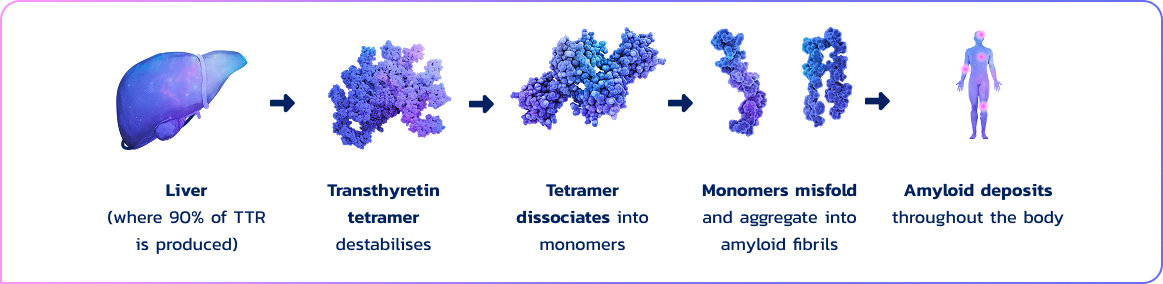
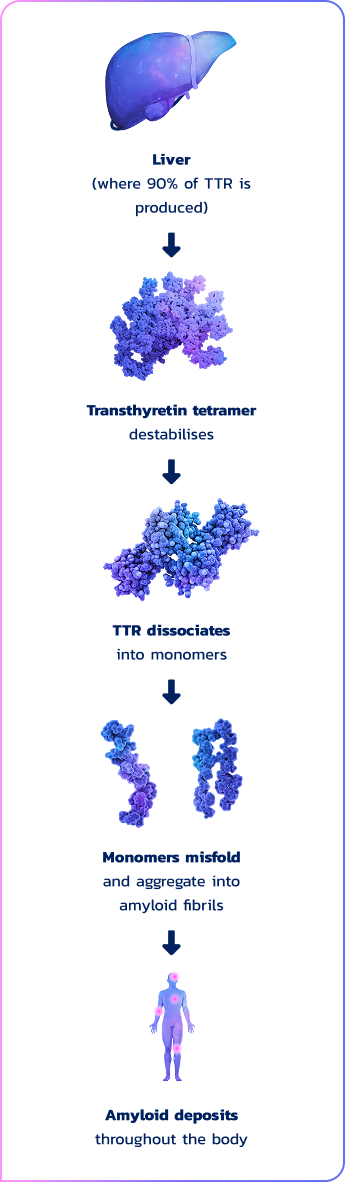
ATTR amyloidosis is a protein-misfolding disease of the transthyretin (TTR) protein1

gradient-line

The source of the disease is TTR which is produced primarily in the liver3,19

Liver Icon
Liver

(where 90% of TTR is produced)

arrow icon
arrow icon
Transthyretin tetramer destabilizes
Transthyretin
tetramer destabilises
arrow icon
arrow icon
Tetramer dissociates into monomers
arrow icon
arrow icon
Monomers Misfold And Aggregate Into Amyloid Fibrils
Monomers misfold
and aggregate into amyloid fibrils
arrow icon
arrow icon
Amyloid deposits throughout the body
about-imageabout-image

Watch this video to learn more about the disease mechanism of ATTR amyloidosis

The disease is classified as hereditary or wild type19

gradient-line
ionic-md-checkmark-circle-outline
Hereditary ATTR (ATTRv):

Instability of TTR is due to mutations in the TTR gene1,19

ionic-md-checkmark-circle-outline
Wild-type ATTR (ATTRwt):

Instability of TTR may be due to unknown environmental and age-related factors19

UNDERSTAND MORE ABOUT THE DIFFERENCES BETWEEN HEREDITARY AND WILD-TYPE

ATTRv
  • Age of onset is typically >30 years20
  • Symptoms manifest as cardiomyopathy (CM), polyneuropathy (PN) or both1

ATTRwt
  • Patients are typically aged >60 years and male21
  • Symptoms generally manifest as CM1

Mutations associated with ATTRv amyloidosis

gradient-line
  • The most common TTR mutations in the UK and Ireland are T80A, V142I and V50M22
  • The V142I mutation is predominantly linked to cardiac manifestations; autonomic dysfunction and peripheral neuropathy are clinically rare8,21–23
  • The T80A mutation typically exhibits a mixed clinical phenotype, encompassing both cardiac and neuropathic features21,22
  • It has been shown that around 1 in 1000 people in the UK carry likely pathogenic TTR variants, surpassing known prevalence rates24
  • In the UK, there are thought to be around 600 people with wild-type ATTR-CM and 200 people with hereditary ATTR-CM25
  • The true prevalence of ATTR-CM in the UK is likely underestimated due to potential under-diagnosis and under-reporting of the condition25

Patients are often defined by CM or PN presentation. In the UK, up to 29% of patients with ATTRv and up to 8% with ATTRwt have mixed presentation26

ionic-md-checkmark-circle-outline

Transthyretin amyloidosis with cardiomyopathy (ATTR-CM) is defined as patients presenting with manifestations that predominantly affect the heart1,27

ionic-md-checkmark-circle-outline

Transthyretin amyloidosis with polyneuropathy (ATTR-PN) is defined as patients presenting with manifestations that predominantly affect the peripheral nerves19

It is important to suspect ATTR amyloidosis signs and symptoms to facilitate earlier diagnosis and treatment1

SEE THE SIGNS AND SYMPTOMS

Timely diagnosis and treatment of ATTR amyloidosis may help to improve patient outcomes28

UNDERSTAND DIAGNOSIS

contact-icon

Get in touch

If you have any questions about ATTR amyloidosis in the United Kingdom or would like to speak to an AstraZeneca medical representative, please contact us

Get in touch

ATTR=transthyretin amyloidosis; ATTR-CM=transthyretin amyloidosis with cardiomyopathy; ATTRv=hereditary transthyretin amyloidosis; ATTRv-PN=hereditary transthyretin amyloidosis with polyneuropathy; CM=cardiomyopathy; PN=polyneuropathy; TTR=transthyretin.


References: 1. Nativi-Nicolau JN, et al. Heart Fail Rev. 2022;27(3):785–793; 2. Gertz M, et al. BMC Fam Pract. 2020;21(1):198; 3. Tschöpe C and Elsanhoury A. J Clin Med. 2022;11(8):2148; 4. Costa PP, et al. Proc Natl Acad Sci USA. 1978;75(9):4499–4503; 5. Saraiva MJM, et al. J Clin Invest. 1984;74(1):104–119; 6. Westermark P, et al. Ups J Med Sci. 2014;119(3):223–228; 7. Lane T, et al. Orphanet J Rare Dis. 2015;10:O26(Suppl 1); 8. Adams D, et al. Neurology. 2015;85(8):675–682; 9. Nativi-Nicolau J, et al. ESC Heart Fail. 2021;8(5):3875–3884; 10. Coelho T, et al. JAMA. 2023;330(15):1448–1458; 11. Adams D, et al. Amyloid. 2023;30(1):1–9; 12. Benson M, et al. N Engl J Med. 2018;379:22–31; 13. Adams D, et al. N Engl J Med. 2018;379:11–21; 14. Hawkins PN, et al. Ann Med. 2015;47(8):625–638; 15. Garcia-Pavia P, et al. J Card Fail. 2024;S1071-9164(24)00222-7; 16. Gonzalez-Lopez E, et al. JACC CardioOncol. 2022;4(4):442–454; 17. Law S, et al. Eur Heart J. 2022;43(27):2622–2632; 18. Dungu JN, et al. Circ Heart Fail. 2016;9(9):e003352; 19. Ioannou A, et al. BioDrugs. 2023;37(2):127–142; 20. Kroi F, et al. Cardiol Ther. 2021;10(1):41–55; 21. Griffin JM, et al. JACC CardioOncol. 2021;3(4):488–505; 22. Gillmore JD, et al. Adv Ther. 2022;39(6):2292–2301; 23. Parker MM, et al. Sci Rep. 2019;11(1):11645; 24. Aung N, et al. JAMA Cardiol. 2024; 25. NICE. Tafamidis for treating transthyretin amyloid cardiomyopathy (review of TA696). Available at: www.nice.org.uk/guidance/ta984/documents/draft-scope-post-referral. Accessed April 2025; 26. Porcari A, et al. Eur J Heart Fail. 2023;25(4):515–24; 27. Witteles RM, et al. JACC Heart Fail. 2019;7(8):709–716; 28. Rozenbaum MH, et al. J Comp Eff Res. 2021;10(11):927–938.

GB-62816 I April 2025

WELCOME TO THE SEE THE PATTRNS WEBSITE

This is a non-promotional AstraZeneca website intended for UK healthcare professionals.

By clicking "I am a UK Healthcare Professional" you are declaring and confirming that you are a Healthcare Professional within the UK and have read and understood this disclaimer. Clicking "I am NOT a UK healthcare professional" will take you to www.astrazeneca.co.uk

Patients or members of the public: This website is intended for healthcare professionals only. Please speak to your healthcare provider if you require further information about ATTR amyloidosis.

I AM NOT A UK HEALTHCARE PROFESSIONAL
  • AstraZeneca Logo
  • Cookies
  • Legal Notice and Terms of Use
  • Privacy Notice
  • Contact us

The information on this website has been created and funded by AstraZeneca UK for educational purposes only. The content is intended for UK healthcare professionals and should not be used for diagnosing or treating a health problem or disease.


©2025 AstraZeneca. All rights reserved. GB-70859 | December 2025